AI Generated Content Disclosure Law 2026
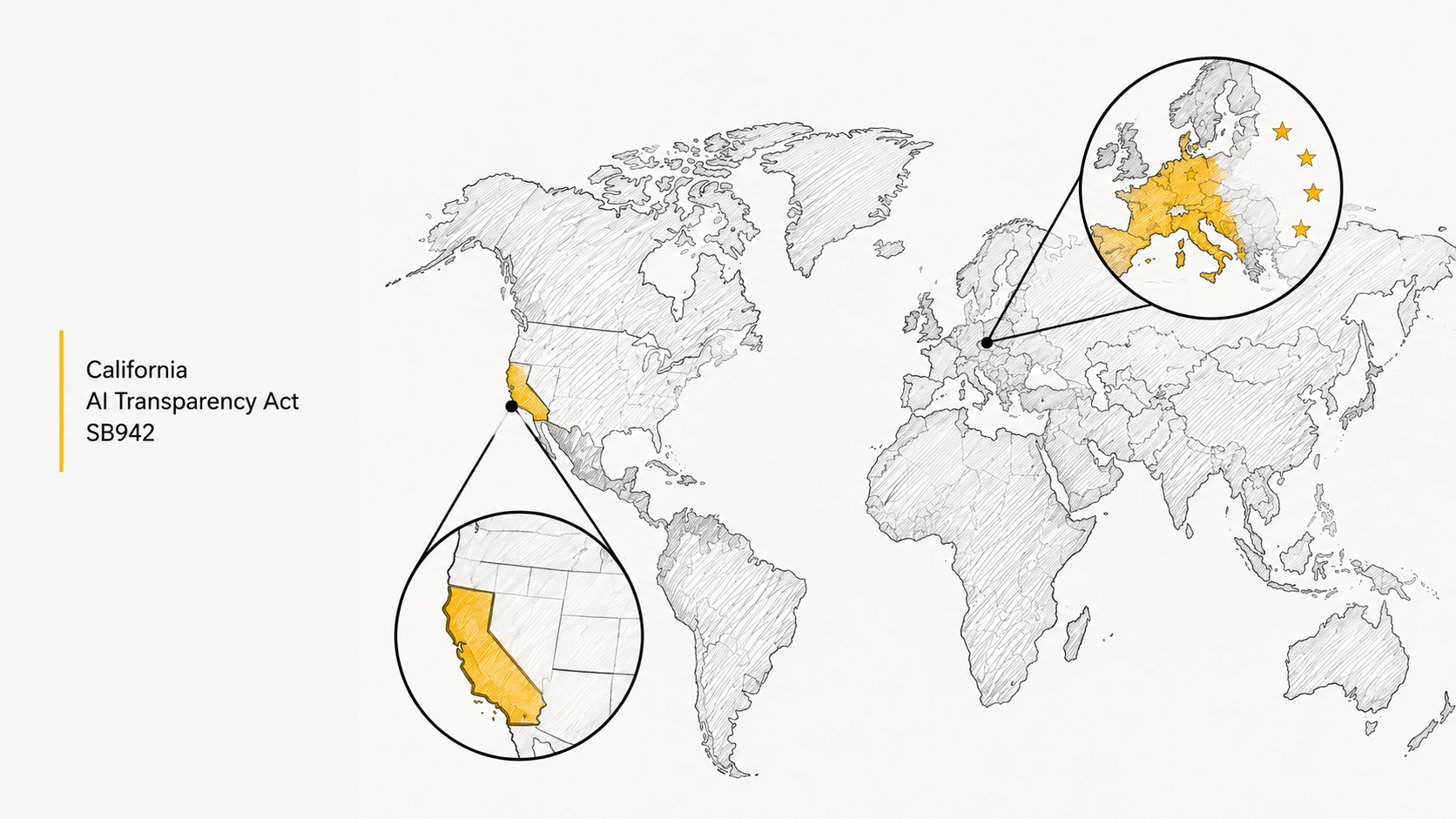
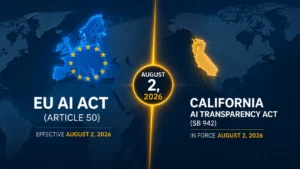
A new AI generated content disclosure law is now active on both sides of the Atlantic. The EU’s AI Act (Article 50) took effect on August 2, 2026, and California’s AI Transparency Act (SB 942) went into force the same day. If you’re publishing AI-made video, images, or text — even from tools like Kling, Veo, or ChatGPT — there’s a real chance one of these laws already applies to you.
Most coverage of these laws is written for lawyers and enterprise compliance teams. This isn’t that. This is what the two laws actually require, and — more usefully — whether they apply to a solo creator, a small marketing team, or an agency publishing AI content day to day.
What actually changed on August 2, 2026
Two separate laws, same effective date, roughly the same goal: make it possible to tell AI-generated content apart from the real thing.
- The EU AI Act’s Article 50 requires AI providers to mark synthetic audio, image, video, and text so it’s machine-detectable, and requires certain professional users (“deployers”) to disclose deepfakes and AI-generated public-interest text.
- California’s SB 942 (AI Transparency Act), as amended by AB 853, requires large generative AI providers — systems with more than 1 million monthly users accessible in California — to offer a free public AI-detection tool and embed provenance data in their outputs.
The short version: the heaviest obligations fall on the AI platforms themselves (Kling, Veo, OpenAI, and similar), not on everyday users. But if you’re publishing realistic AI content professionally — ads, marketing video, anything that could pass as real — you likely have a smaller, separate disclosure obligation too. More on that below.
The EU AI Act’s Article 50, explained without the legal language
Who counts as a “provider” vs. a “deployer”
Article 50 splits responsibility into two roles:
- Providers — the companies that build and release the AI system (Kling’s developer, Google for Veo, OpenAI, etc.). They carry the heavier technical burden: embedding machine-readable marks in generated content and making that content detectable as AI-made.
- Deployers — anyone who uses that AI system professionally to produce content for others to see. If you’re a marketer, agency, or creator publishing AI-made video or images as part of a business, you’re a deployer, not a provider.
What deployers specifically have to disclose
If you’re a deployer, Article 50 mainly asks you to do one thing: disclose when content is a deepfake, or when AI-generated text is being published to inform the public on a matter of public interest. A “deepfake” here means image, audio, or video content that’s been AI-generated or manipulated to resemble real people, places, or events in a way that would appear authentic.
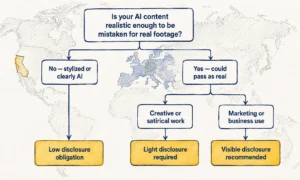
There’s a genuinely useful carve-out for creative work: if the content is evidently artistic, satirical, fictional, or part of a similar creative work, the disclosure only needs to note that generated or manipulated content exists somewhere in the piece — worded in a way that doesn’t ruin the experience of watching or reading it. A stylized AI-generated product ad or an obviously fictional short film has a much lighter obligation than, say, a synthetic video of a real public figure.
Penalties
Non-compliance can trigger fines up to €15 million or 3% of a company’s worldwide annual turnover, whichever is higher — enforced by national market surveillance authorities in each EU member state. That scale of penalty is aimed at large providers, not solo creators, but it signals how seriously the EU is treating this.
One relief: content published before August 2, 2026 doesn’t need to be retroactively labeled. The obligation is forward-looking.
California’s SB 942 (AI Transparency Act), explained without the legal language
Who’s actually “covered”
This is the detail most articles bury: SB 942 only directly applies to “covered providers” — generative AI systems with more than 1 million monthly visitors or users accessible in California. That’s platforms like Kling, Veo, ChatGPT, and similar large tools, not the individual businesses or creators using them.
What covered providers have to build
Covered providers must offer a free, publicly accessible AI-detection tool (with both a web interface and an API) that doesn’t retain submitted content or collect personal information. They also have to embed C2PA-compatible provenance data — provider name, system name and version, creation timestamp, and a unique content ID — directly into image, video, and audio outputs. An optional visible label is allowed on top of that.
Penalties
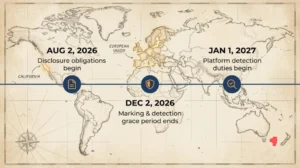
$5,000 per violation, with each day of non-compliance counted separately, enforced by California’s Attorney General or local city/county attorneys. Starting January 1, 2027, a new category — “large online platforms” like social media networks and search engines — will also have to detect and surface that provenance data to users. Device manufacturers face a separate, later deadline (January 1, 2028) for building disclosure options into cameras and recording hardware.
Does this actually affect you if you’re just using Kling, Veo, or ChatGPT?
Realistically, most of the technical heavy lifting — watermarking, detection tools, provenance metadata — is the AI platform’s job, not yours. Several major generative AI providers have already signed onto the EU’s voluntary Code of Practice on AI content transparency, which means the marking is increasingly happening automatically in the background.
Where you do have a personal obligation:
If you’re a solo creator or small marketing team publishing stylized, obviously-AI content (product demos, social clips, illustrated explainers) — your exposure is low. The creative-work carve-out in Article 50 likely covers you, and neither law’s direct penalties target individuals or small operators.
If you’re producing realistic content that could be mistaken for real footage — a synthetic video of a real person, a “testimonial” that never happened, anything resembling news or a public announcement — you’re the kind of deployer Article 50 is actually aimed at, and a simple, visible disclosure (“This video was created using AI”) is the safe move regardless of your size.
If you’re running paid advertising in the EU or California, it’s worth checking whether your ad platform or agency already handles disclosure, since this is exactly the kind of use case regulators are watching first.
A practical checklist
- Check whether your AI tool already embeds a disclosure or watermark. Many major providers now do this by default as part of the EU’s Code of Practice.
- Add a simple visible label (“Created with AI” or similar) to anything realistic enough to be mistaken for authentic footage — cheap insurance, takes ten seconds.
- Don’t worry about retroactive labeling — content published before August 2, 2026 is exempt.
- If you run ads or content specifically targeting EU or California audiences, treat disclosure as a standard part of your content checklist, not an afterthought.
- Re-check this space in December 2026 and January 2027 — both the EU’s marking grace period and California’s large-platform rules kick in around then, and requirements will tighten.
FAQ
Do I have to label every AI-generated image or video I post? Not necessarily. Obviously stylized or clearly fictional AI content generally falls under lighter disclosure rules. Realistic content that could pass as authentic — especially involving real people — carries the strongest obligation to disclose.
Does this apply to me if I’m not based in the EU or California? Yes, potentially. The EU AI Act applies to anyone whose AI-generated content is used or accessed within the EU, regardless of where the creator is based. The same logic applies to California’s law for California users.
What happens to content I posted before August 2026? It doesn’t need to be retroactively labeled under either law.
Are Kling, Veo, and ChatGPT compliant already? Major providers are actively rolling out compliance — several have signed the EU’s Code of Practice — but implementation is still in progress through the December 2026 grace period. Check your specific platform’s current documentation rather than assuming.
What’s the actual penalty if I don’t comply? For large AI providers, up to €15 million or 3% of global turnover (EU) or $5,000 per day (California). Individual creators and small deployers aren’t the primary enforcement target, but visible disclosure on realistic content is a low-effort way to stay clearly on the right side of both laws.
Bottom line
Neither law expects a solo creator or small marketing team to build detection tools or embed watermarking infrastructure — that’s on the platforms. What it does ask of you is small and specific: if what you’re publishing is realistic enough to be mistaken for something real, say it’s AI-made. That’s a five-second habit, not a compliance program, and it happens to be good practice regardless of what the law says.
This is general information, not legal advice. If your business has meaningful EU or California exposure, a quick check with counsel is worth it before you scale AI content production.